

Blog
What is Mapaho Labs?

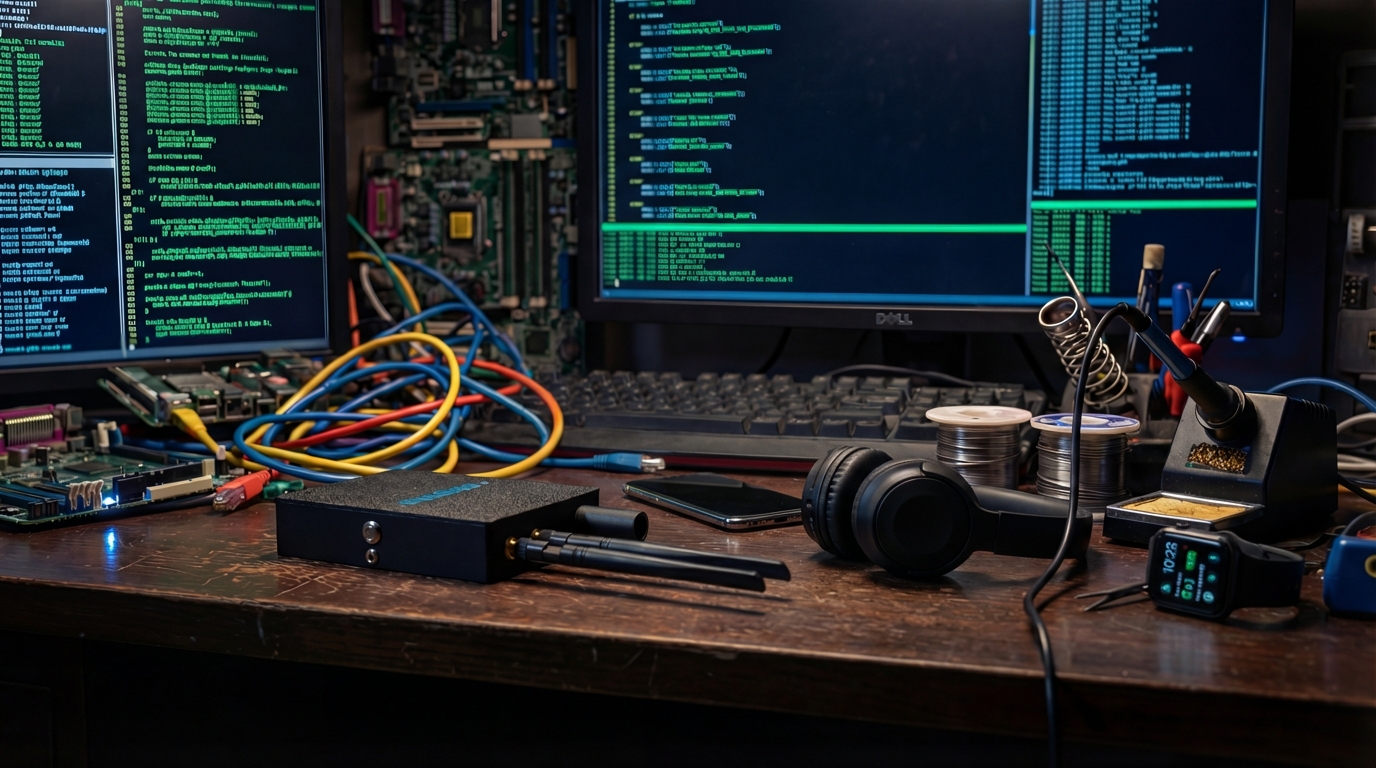
From the iT-Lab to the product: How Mapaho Labs developed GoTailMe
A device for surveillance detection should not cost more than the car it protects. And you should not need a security clearance to operate it. We built GoTailMe because nothing else existed in between.
Who is Mapaho Labs
Mapaho Labs is a European hacker-lab for digital reconnaissance products. We develop tools that turn raw signal data into actionable security information. The kind of tools we would have needed ourselves, but could not find anywhere.
Our team works at the intersection of wireless security research, embedded systems, and threat analysis. We are not a startup chasing growth metrics. We are engineers who read Bluetooth specifications at night and test detection algorithms in the field on weekends. Every product we deliver solves a problem we have experienced ourselves.
GoTailMe is our first commercial product — and the one that showed us there is a market for what we do.
The gap that no one filled
The monitoring market for surveillance detection has a strange shape. On one side there are free smartphone apps that look for nearby AirTags and can do little more. They are limited by the capabilities of a smartphone. They cannot monitor WiFi probe requests. They cannot perform GPS correlation. Whole categories of tracking devices evade them.
On the other side is professional TSCM equipment. RF spectrum analyzers, nonlinear junction detectors, thermal imaging systems. Effective, but priced between five thousand and fifty thousand euros, and it takes trained operators to interpret the results.
In between? Almost nothing.
In this exact gap lives GoTailMe. A portable, standalone device that conducts continuous surveillance detection over WiFi, Bluetooth, and airspace threats at a price accessible to security consultants, journalists, and privacy-conscious individuals. No training required. No cloud accounts. No subscriptions. Power on, and it starts working.
The Detection Engine
Development began in November 2025. The first version was simple:
Monitor WiFi probe requests, label devices that appear too often, and display the results in a dashboard. It worked, but covered only one attack vector.
Within weeks Bluetooth Low Energy scanning was added. Not only for known trackers, for everything. Every BLE device in range leaves a fingerprint: smartwatches, headphones, fitness trackers, TPMS tire pressure sensors, car dash cams, medical devices. GoTailMe captures and profiles them all. If the same headphones appear at every location you visit, the system will report it. A dedicated tracker is an obvious threat. A phone or a smartwatch following you is a subtler and often more dangerous threat because it is attached to a person.
The Stalker Scoring algorithm was one of the hardest problems. How do you distinguish between a neighbor’s AirTag on the way to work and one hidden in your pocket? The answer is behavior analysis over time: appearance patterns, proximity duration, geographic correlation, signal strength trends. We settled on a 0–100 rating system that accounts for all these variables, calibrated by months in field use.
GPS changed everything
The biggest leap in detection came with GPS integration. Before GPS, the system could tell you what was nearby. After GPS integration, it could tell you if you were being tracked.
There is a crucial difference between detecting a device and confirming a follower. A Bluetooth tracker in a cafe is noise. The same tracker in the cafe, your office, and your home is a confirmed threat. GoTailMe’s Confirmed Follower Detection requires evidence from multiple locations before an alert escalates, which means fewer false positives and significantly higher confidence when a real threat is identified.
To achieve this we developed the Geiger mode: once a potential tracker is reported, switch the device to Proximity Scan. Acoustic signals intensify as you approach the tracker. It turns the device into a handheld sweep tool — walk around your car, your bag, your office and locate exactly where the tracker is hidden.
Expansion of the threat model
WiFi and Bluetooth covered ground-level surveillance. But the threat landscape also includes the airspace.
Early 2026 we added a complete drone detection pipeline. GoTailMe now monitors RemoteID transmissions (the ASTM standard most consumer drones broadcast), DJI’s proprietary Bluetooth protocol, and WiFi-based drone fingerprints. It captures flight telemetry, marks suspicious patterns like loitering, identifies operator locations when available, and even detects spoofed RemoteID transmissions. Drones broadcasting false identification data.
That was not originally planned. But once we had a platform that could monitor multiple radio channels simultaneously and correlate with GPS data, drone detection became a natural extension of the architecture.
Zero-Cloud by Design
Early in development we made a decision that shaped everything to come: no cloud connectivity. Never.
A surveillance device that phones home is a contradiction. Your threat data — where you go, what follows you, when you are most vulnerable — is exactly the kind of information that should never leave your possession.
GoTailMe processes everything locally. There are no user accounts. No telemetry. No analytics. No API calls to external servers. The dashboard runs on the device itself, accessible through the built-in wireless access point. Connect your phone or laptop directly, no internet required.
This constraint made development harder. We could not offload any computations. We could not use cloud-based machine learning. Every algorithm had to run efficiently on embedded hardware in real time. But it is the right trade-off. Privacy is not a feature; it is the foundation.
From prototype to product
GoTailMe went from first commit to production hardware in under four months. Over 200 commits. Three independent detection channels. A fully browser-based dashboard with real-time threat maps, device overviews, and professional reporting. Export formats for GeoJSON, KML, HTML, and Markdown — because when you document a threat for a client or for law enforcement, presentation matters.
The device ships pre-configured and tested. There is no setup wizard, no firmware flashing, no configuration files. Power on, connect to the access point, open the dashboard. You will detect threats within seconds of unboxing.
Software updates are automatic; connect the device to a network and it downloads the latest version. No manual intervention, no version tracking, no maintenance.
Who is it for
We built GoTailMe for people who take their personal safety seriously:
- Security consultants and TSCM specialists who need a portable detection tool that complements their existing equipment
- Protection details teams that monitor vehicles and protected persons for tracking devices
- Investigative journalists working in environments where surveillance is a real and present risk
- Privacy-conscious individuals who want to know if they are being followed without needing a security background to interpret the results GoTailMe does not replace a full TSCM review. It does something else: continuous, passive, automated surveillance that works while you go about your daily life. Think of it as a smoke detector for surveillance—always on, always awake, and alerting you when something is off.
What’s next
GoTailMe is our first product, not our last. Mapaho Labs is building a pipeline of digital reconnaissance tools, each designed to give individuals and small teams capabilities that used to be available only to well-funded authorities.
We do not announce products before they are ready. But if you are interested in our work, GoTailMe is the best hint of how we think: practical, field-tested, privacy-by-default, and built to close gaps the market tends to ignore.
GoTailMe coming soon — only at Mapaho.com
For further questions simply use the chat on GoTailMe.com.
Made in EU. No subscription. No cloud. No compromises.


